Research material profile
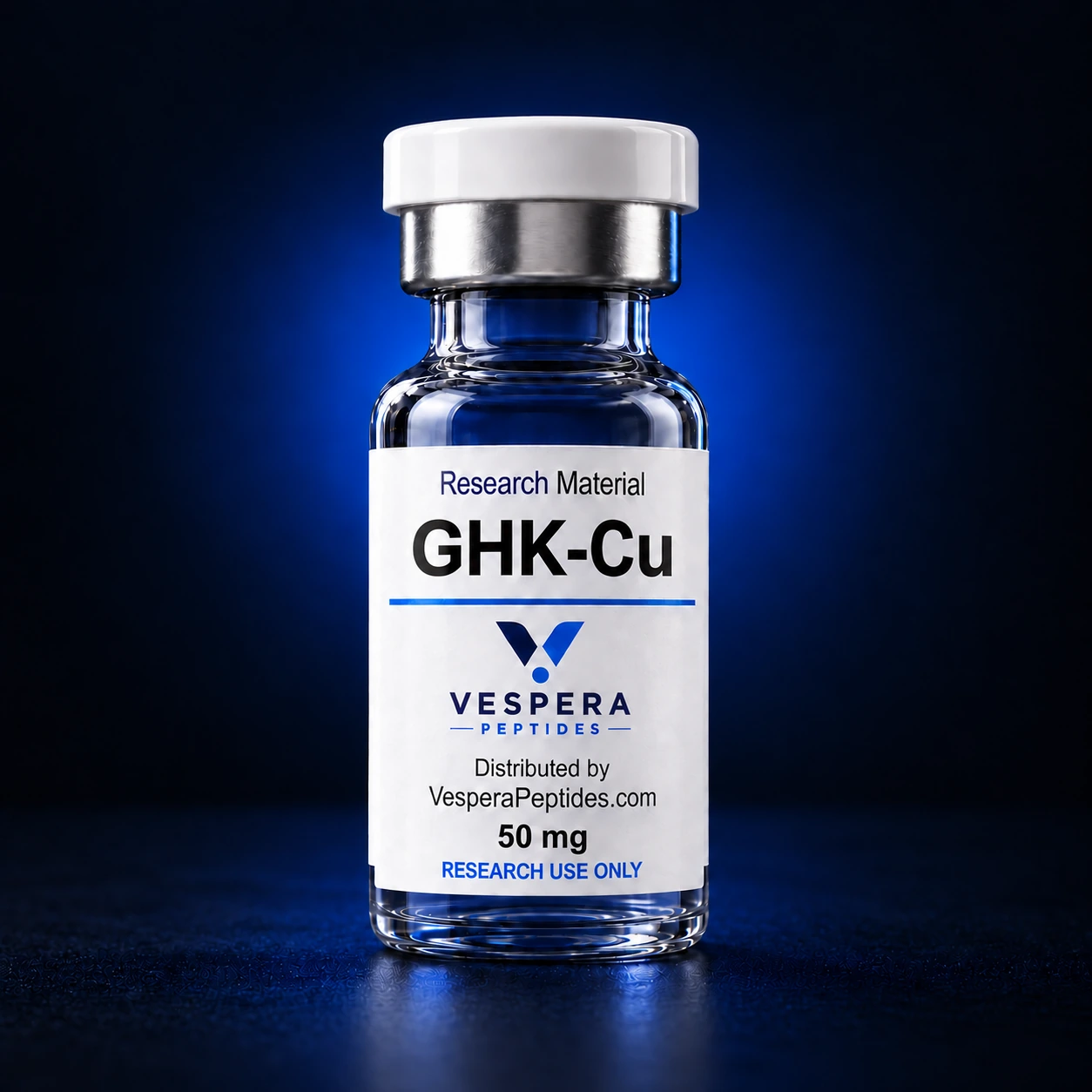
GHK-Cu
Copper(II) complex of a tripeptide
GHK-Cu is a coordination complex formed by the tripeptide glycyl-L-histidyl-L-lysine and copper(II). Research often examines fibroblast behavior, extracellular-matrix signaling, and copper-dependent effects.
- Identity shorthand
- Gly-His-Lys · Cu(II)
- Evidence map
- Primarily cell and material-system evidence
- Public page scope
- Identity and literature context; no purchase offer
Pricing, availability, ordering, cart, and checkout remain inside the reviewed qualified-access portal.
Plain-language identity
What GHK-Cu is
GHK-Cu is a coordination complex formed by the tripeptide glycyl-L-histidyl-L-lysine and copper(II). Research often examines fibroblast behavior, extracellular-matrix signaling, and copper-dependent effects.
- Research class
- Copper(II) complex of a tripeptide
- Sequence / identity shorthand
Gly-His-Lys · Cu(II)- Evidence map
- Primarily cell and material-system evidence
The peptide, the copper ion, and their complex are analytically distinct. A peptide purity result alone does not establish copper loading, complex stoichiometry, quantity, or suitability for a study.
What researchers examine
- Fibroblast collagen synthesis and extracellular-matrix remodeling in cell culture.
- Copper-dependent changes in matrix metalloproteinase and inhibitor expression.
- How metal-to-ligand ratio, oxidation state, and analytical method affect material characterization.
How to read the evidence
- A 1988 fibroblast-culture study reported changes in collagen synthesis after exposure to GHK-Cu.
- A 2000 fibroblast-culture study reported changes in MMP-2 and tissue-inhibitor expression and distinguished effects of the complex, copper, and GHK alone.
- These are model-system observations; they do not establish a consumer, cosmetic, or clinical outcome for this catalog material.
What this evidence does not establish
- Cell-culture findings do not establish safety, efficacy, sterility, or performance in a person or animal.
- FDA identifies limited human safety data and immunogenicity and impurity concerns for compounded injectable drugs containing GHK-Cu.
- The Vespera item is a research material, not a cosmetic, medicine, compounded preparation, or approved drug.
Documentation checklist
- Review the named chemical form and whether copper content or stoichiometry was measured.
- Match SKU, nominal quantity, lot, method, reported mass, and purity or composition result.
- Separate peptide identity, copper content, microbial controls, and endotoxin data; one result does not substitute for the others.
Primary and official sources
Links are provided for source review. A citation is not an endorsement of nonresearch use.
- Maquart et al. — GHK-Cu and collagen synthesis in fibroblast culture (1988)In vitro fibroblast study.
- Siméon et al. — GHK-Cu and MMP-2 expression in fibroblast culture (2000)In vitro extracellular-matrix remodeling study.
- FDA — bulk substances that may present significant safety risksRegulatory context for compounded injectable drugs containing GHK-Cu.